PART/ PYD 2597
Ultra-Low-Power DigiPyro Lead-free Dual-Element Detector PYD 2597
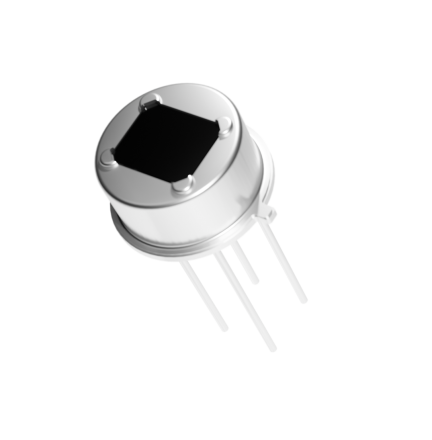
The Excelitas ultra-low-power DigiPyro® PYD 2597 detector operates at just 1.4 V. This fully integrated, two-element pyro detector is made from RoHS-compliant materials and is designed to maximize battery life, making it suitable for remote motion-detection applications. Featuring Excelitas’ signature Wake-Up mode, this detector consumes only 2 µA at 1.8 V, further extending battery life for remote motion detection.
The DigiPyro PYD 2597 ultra-low-power detector sets a new benchmark for power efficiency, with a quiescent current of only 2 µA at 1.8 V and operating down to 1.4 V. It is fully RoHS-compliant and engineered for improved temperature stability, ensuring reliable motion detection across diverse environments. Its Wake-Up mode makes it ideal for battery-powered motion detection in both indoor and outdoor settings.
| Responsivity | 3.2 kV/W (typical) |
| Noise | 5 digits (typ), 8 digits (max) |
| Operating power requirements | 1.4-3.6 V / 2 µA |
| Housing with optical window | TO-5 |
| Field-of-view | 130° |
Ultra-low-power consumption:
- Lowest operating voltage of 1.4 V to 3.6 V
- Low power consumption of 3 µA at 3.3 V and 2 µA at 1.8 V
Integrated digitization:
- Configurable Motion Detection Unit (MDU) with interrupt function
Robust pyroelectric elements:
- Improved temperature stability with faster settling time
- More resilient to fast temperature changes
- Fully RoHS-compliant material
| Responsivity | 3.2 kV/W (typical) |
| Noise | 5 digits (typ), 8 digits (max) |
| Operating power requirements | 1.4-3.6 V / 2 µA |
| Housing with optical window | TO-5 |
| Field-of-view | 130° |
Ultra-low-power consumption:
- Lowest operating voltage of 1.4 V to 3.6 V
- Low power consumption of 3 µA at 3.3 V and 2 µA at 1.8 V
Integrated digitization:
- Configurable Motion Detection Unit (MDU) with interrupt function
Robust pyroelectric elements:
- Improved temperature stability with faster settling time
- More resilient to fast temperature changes
- Fully RoHS-compliant material